Your daily view
Action Center
Where a finding becomes somebody's job: tasks, owners, priorities, projects, subtasks, and where the work came from.
What it is for
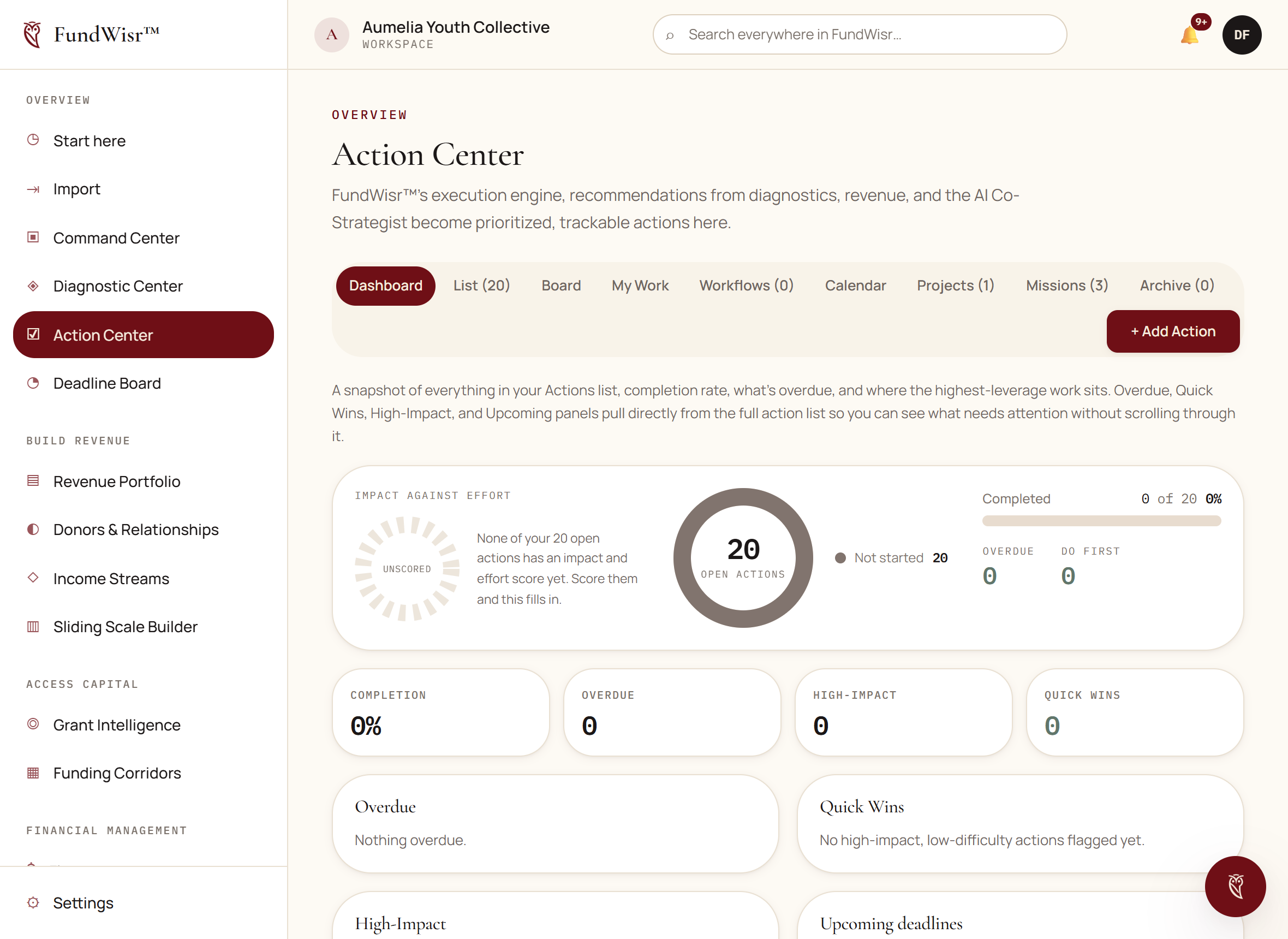
The Action Center is the execution layer. Every other tool can find a problem; this is the only one that can give it an owner and a date. It is a real task system: assignment to named people, subtasks, blocking dependencies, comments, and two ways of grouping work.
Where actions come from
Most actions are not typed in. They arrive from the tool that found the problem, and they keep a badge saying so, so six weeks later you can still tell whether something was a diagnostic finding, a compliance gap, or an idea somebody had in a meeting.
- Diagnostic Center sends the gaps a diagnostic found.
- Risk & Compliance sends missing policies and lapsed requirements.
- Grant Intelligence and Funding Corridors send pursuit work for opportunities you marked.
- Board & Governance sends outstanding acknowledgments and governance follow-ups.
- The AI Co-Strategist can create actions directly when you ask it to.
- Anything you add yourself is labeled as entered manually.
Priorities
| Priority | Use it for |
|---|---|
| Critical | Something is actively breaking or a legal deadline is at risk. |
| High | Important, and there is a date it stops being possible. |
| Medium | Real work with no cliff edge. Most things live here. |
| Low | Worth doing, and nothing changes if it waits a quarter. |
Projects and missions
- A mission
- A lightweight strategic grouping, like "Become grant ready". Use it to gather work that shares a goal but has no schedule of its own.
- A project
- A real container with a timeline and structure. Use it when the work has phases, dependencies, and an end.
An action can belong to either, both, or neither. Neither is a perfectly good answer for a single task.
Assigning work well
- One owner per action. Two owners is nobody's job. Use subtasks if two people genuinely each have a piece.
- A date on everything you actually intend to happen. Undated actions do not appear on the Deadline Board and quietly become a list nobody reads.
- Dependencies for things that truly block. Marking an action as blocked by another is different from marking it a subtask: a subtask is part of the work, a dependency is a reason it cannot start.
- Comments rather than a rewritten title. The history of what changed is worth more than a tidy title.
Read next
- Deadline BoardEvery dated obligation you have, from every tool, on one page, sorted by how soon it hurts.
- Command CenterYour home page: the resilience score, what needs your attention, and the recommended action plan built from everything else in the software.
- Diagnostic CenterAll thirteen diagnostics, when to use each one, and how re-running them over time turns a score into a trend.
Something here wrong, missing, or out of date? Email support@fundwisr.ai and tell us which chapter. Documentation defects are treated as defects.