Growing
Property Finder
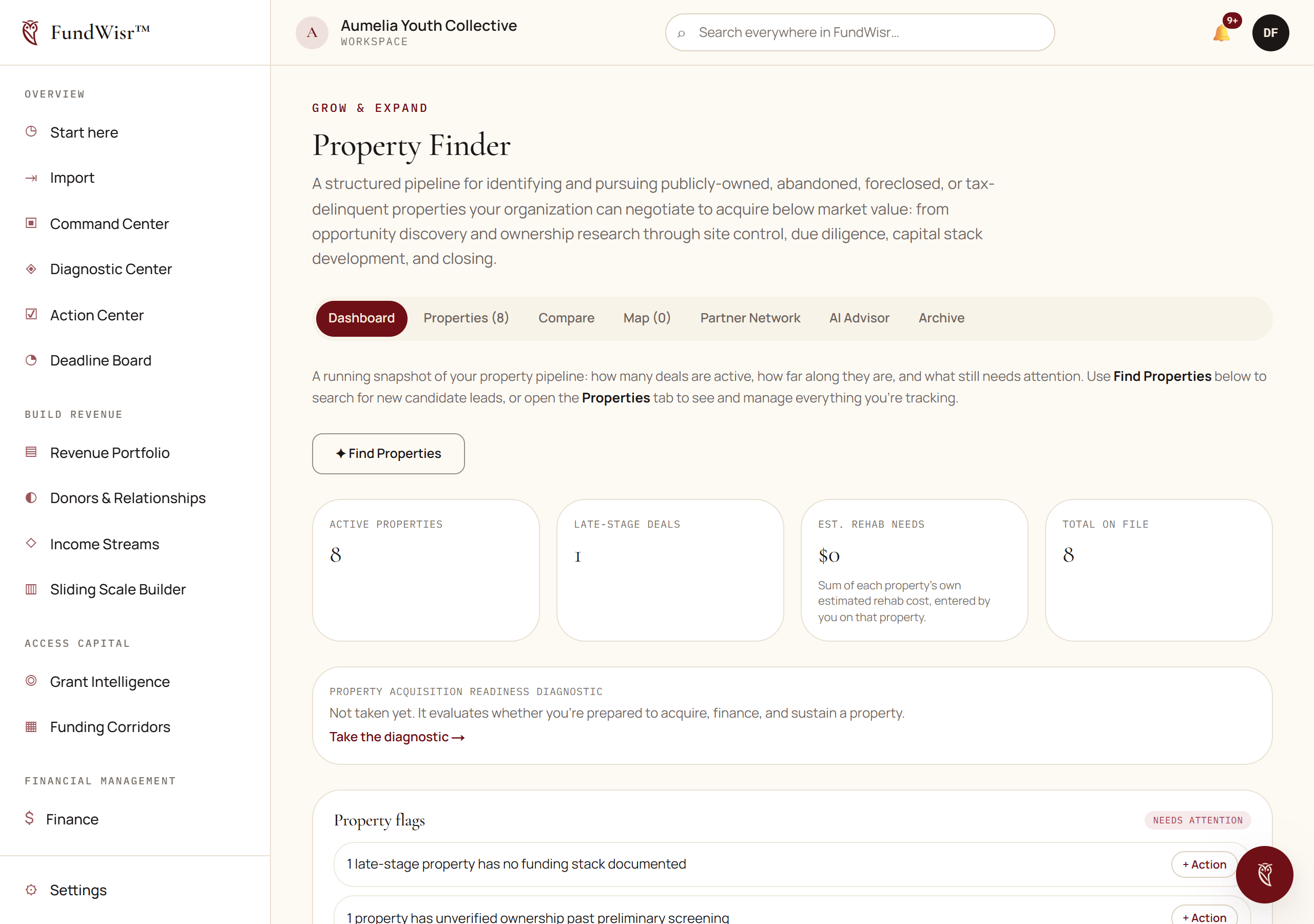
Acquiring and redeveloping a building, through a fifteen-stage lifecycle that puts the cheap questions before the expensive ones.
The fifteen stages
Property acquisition is the longest and most expensive process in this software, and the order of the stages is the point. Everything that can kill a deal cheaply is asked before anything that costs money to find out.
| Stage | The question it answers |
|---|---|
| Need Identification | What do we actually need space for. |
| Organizational Readiness | Are we in a position to own a building at all. |
| Opportunity Discovery | What is out there. |
| Preliminary Screening | Which of these are worth a second look. |
| Ownership & Disposition Research | Who owns it, and can it even be transferred. |
| Government Engagement | What do the people who control it want. |
| Preliminary Feasibility | Could this work, roughly. |
| Conditional Site Control | Can we hold it while we find out properly. |
| Full Due Diligence | What is actually wrong with it. |
| Deal Structuring | How is this transaction shaped. |
| Capital Stack Development | Where does every dollar come from. |
| Approval & Closing | Board, funders, lawyers, signatures. |
| Rehabilitation & Construction | Making it usable. |
| Occupancy & Activation | Moving in and opening. |
| Ongoing Compliance | Everything ownership obliges you to forever. |
Due diligence and stop-deal warnings
Due diligence is organized by category rather than as one flat list, and some findings are marked as stop-deal warnings: things that should end your interest rather than be negotiated around.
Each property also records how confident you are in two separate things: the evidence of who owns it, and whether it is genuinely available. Those are different questions, and a property with strong ownership evidence and no real availability has wasted more nonprofit time than any other category.
The capital stack
The tool keeps the cost side and the funding side separately: budget line items for what it will cost, capital stack sources for where the money comes from. The gap between them is the number that matters, and keeping them apart is what makes it visible.
- Every source records its own certainty, the same way Revenue Portfolio does. A committed grant and a hoped-for one are not the same dollar.
- Include the costs people forget: carrying costs during construction, furniture, technology, moving, and the first year of higher utilities.
- Record the ongoing compliance obligations when you take the money, not when somebody asks. Property funding usually comes with decades of them.
Read next
- Facilities & AssetsThe buildings you occupy, the equipment you own, the vendors who service them, and the requests to buy more.
- Funding CorridorsCapital that is not a grant: contracts, investment, loans, accelerators, and the certification programs that open doors to them.
- Document StudioGenerating the documents a nonprofit needs, from a library of hundreds, with questions that draw the answer out of you rather than a blank page.
Something here wrong, missing, or out of date? Email support@fundwisr.ai and tell us which chapter. Documentation defects are treated as defects.